 Bjorn3D.com Bjorn3d.com – Satisfying Your Daily Tech Cravings Since 1996
ASUS MATRIX HD 7970 Platinum
Testing & Methodology
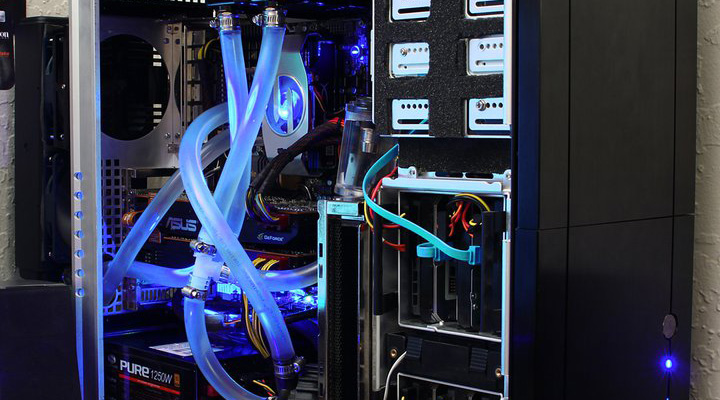
We’ve expanded our testing suite considerably since the X79 chipset release, and will continue to use the same methods for most of the motherboards and CPU’s we test. In the interests of thoroughness and accurate results, we run each test at least three times, and some tests more than that. We average the total of all the tests from each benchmark then report the average here.
The OS we use is Windows 7 Pro 64bit with all patches and updates applied. We also use the latest drivers available for the motherboard and any devices attached to the computer. We do not disable background tasks or tweak the OS or system in any way. We turn off drive indexing and daily defragging. We also turn off Prefetch and Superfetch. This is not an attempt to produce bigger benchmark numbers. Drive indexing and defragging can interfere with testing and produce confusing numbers. If a test were to be run while a drive was being indexed or defragged, and then the same test was later run when these processes were off, the two results would be contradictory and erroneous. As we cannot control when defragging and indexing occur precisely enough to guarantee that they won’t interfere with testing, we opt to disable the features entirely.
Prefetch tries to predict what users will load the next time they boot the machine by caching the relevant files and storing them for later use. We want to learn how the program runs without any of the files being cached, and we disable it so that each test run we do not have to clear Prefetch to get accurate numbers. Lastly we disable Superfetch. Superfetch loads often-used programs into the memory. It is one of the reasons that Windows occupies so much memory. Vista fills the memory in an attempt to predict what users will load. Having one test run with files cached, and another test run with the files un-cached would result in inaccurate numbers. Again, since we can’t control its timings so precisely, it we turn it off. Because these four features can potentially interfere with benchmarking, and and are out of our control, we disable them. We do not disable anything else.
We are revamping our testing method in order to better represent motherboard performance and offering to the consumer. Also we want to make it an easier read for you without miles of endless charts. We ask that you provide feedback in an effort to help us deliver better reviews for you.
Test Rig
| Test Rig | |
| Case | Thermaltake Level 10 GT |
| CPU | Intel Core i7-3770K/Intel Core i7-2600K |
| Motherboard | ASUS Maximus V Gene |
| Ram | 16GbpsB Patriot Viper Xtreme 2400MHz + |
| CPU Cooler | Swiftech H20-220 Edge |
| Hard Drive | Western Digital Velociraptor 300GB |
| SSD | Intel 510 series SATA III 120GB |
| Optical | ASUS BD-ROM |
| GPU | ASUS MATRIX HD 7970 Platinum |
| Additional Cards |
N/A |
| PSU | Thermaltake Toughpower XT 1275W Platinum |
| Mouse | Tt eSPORTS Black gaming mouse |
| Keyboard | Tt eSPORTS Meka G1 mechanical gaming keyboard |
Test Suite
We will use the following applications to test the performance of the graphics card.
Synthetic Benchmarks & Games
| Benchmarks |
|---|
| 3DMark11 |
| Alien Vs Predator |
| Batman: Arkham City |
| Dirt 3 |
| Metro 2033 |
Overclocking

The ASUS MATRIX HD 7970 Platinum is a strong and able card as we see by simply looking at the sum of its parts. But parts only mean so much as the ability to make the card run needs to be in place as well and ASUS does that quite well at the same time.
Starting up the GPU Tweak application we went through the settings and enabled all of the voltage and tweaking options. We were amazed to see two full pages of sliders available to tune everything down to even LLC. This is a level of control we have never seen before, and it is nice to see it. This kind of innovation is what pushes for even better future tuning products from overclocking-friendly companies like ASUS.
Clocking the memory we got to near 1300 MHz, but we experienced very minor artifacts so we tweaked and tuned it to 1275 MHz, which was completely stable for the GPU end. This was a fairly quick overclock, and we cannot see any reason others could not reach it also.
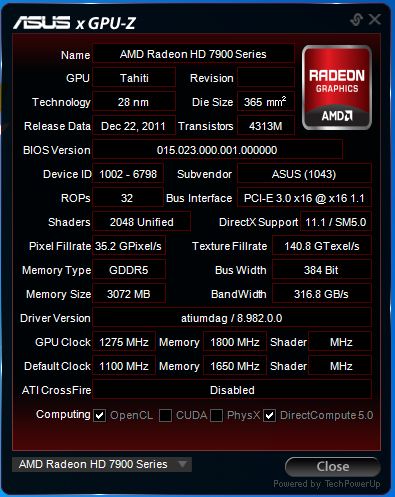
| Clock | Stock Frequency | Max stable MHz |
OC Percent |
| GPU Base clock | 1100MHz | 1275MHz | 16%+ |
| Memory clock | 1650MHz (6600MHz) | 1800MHz (7200MHz) | 9%+ |
Memory overclocking was very good, netting a 7200MHz QDR stable clock, which is just under a 10% overclock, and while that may not seem like much it really is pretty good considering how high this card is clocked out of the box.
In order to ensure no system bottleneck we clocked the CPU to 4.6GHz to ensure there is no reason the system will slow down the cards performance at all.
Some may ask why we chose the mainstream Z77 system, and we can explain. Up until recent the X79 enthusiasts platform did not really support PCIe Gen 3 on the Nvidia 600 series GPU’s. Because of the inherent instability many have seen with the X79 platform with Gen 3 products, Nvidia has been hesitant to enable it, and now there is a workaround via registry to get it working. However, in order to ensure the most consistent testing possible, we have stuck to the natively supported Z77 platform.
Important note: Overclocking can cause component failure. Please exercise caution when attempting any level of overclock on system components.
Temperatures

The temperatures were recorded with full loaded Heaven benchmark looping for over 30 minutes or longer depending how long it took for the card to level out in temps and sat at a plateau for more than 10 minutes.
| GPU Temperatures | Temperature (Idle/Load) |
| ASUS MATRIX HD 7970 Platinum OC | 33C/72C |
| ASUS MATRIX HD 7970 Platinum | 32C/69C |
The MATRIX DCII cooler as we have seen before has proven very effective and the heat dump even when overclocked is easily managed with maybe a mild purr from the DCII’s fans.
Real world/Gaming Benchmarks
3DMARK 11

3DMark 11 is the newest in Futuremark’s suite of benchmarking utilities. Its a fully capable DirectX11 benchmark which also stresses and analyzes the system performance as a whole to simulate a heavy rendering environment such as a high end game or other app the end user may run. This benchmark was run with Performance settings 5 times and all runs were averaged for the result below.
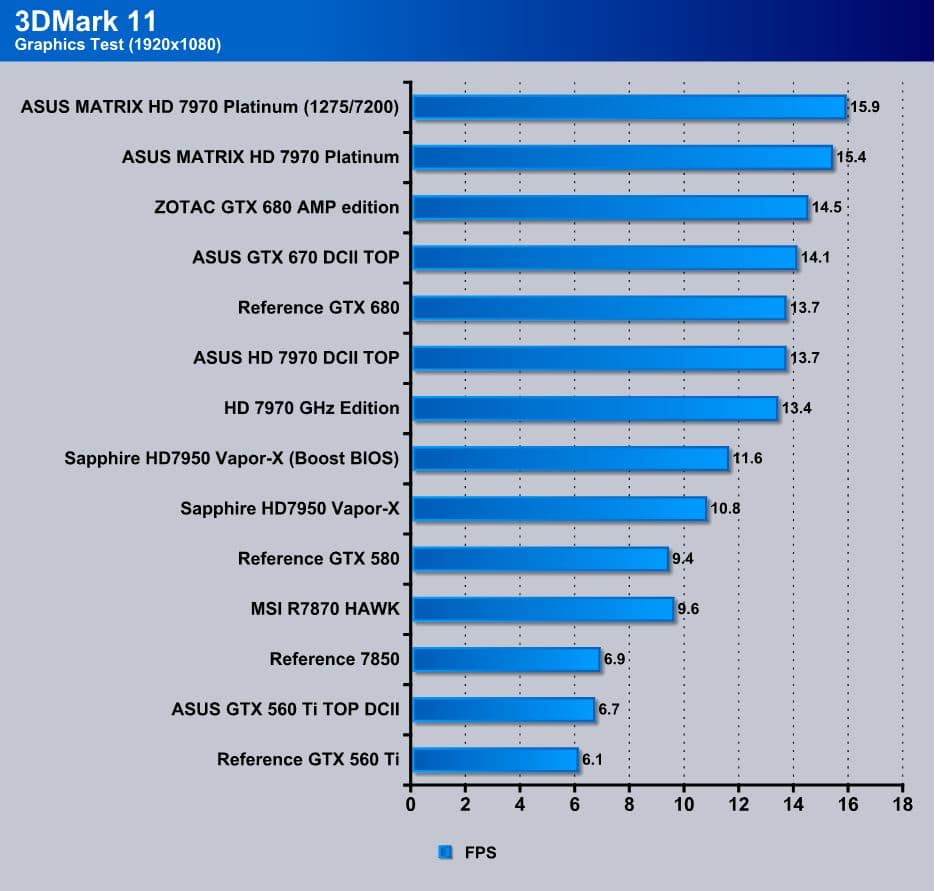
3DMark 11 shows a nice picture of where each card falls in line according by our testbench. The HD 7970 MATRIX blew away even the overclocked variants of the GTX680. When you consider the superb overclock, this lead extends even further.
Alien Vs. Predator

AvP looks like a very AMD friendly game as we see that both the HD 7970 DCII and the MATRIX HD 7970 Platinum top the charts with some very capable FPS results.
Metro 2033


Metro 2033 has always been extraordinarily stressful for GPU’s, and this has not changed with time. Once again this game is definitely a little friendlier with AMD cards and the MATRIX actually puts us in some playable framerates, especially with the overclock which is nice since for the longest time it took dual card setups just to get somewhat playable framerates from this game.
Batman: Arkham City

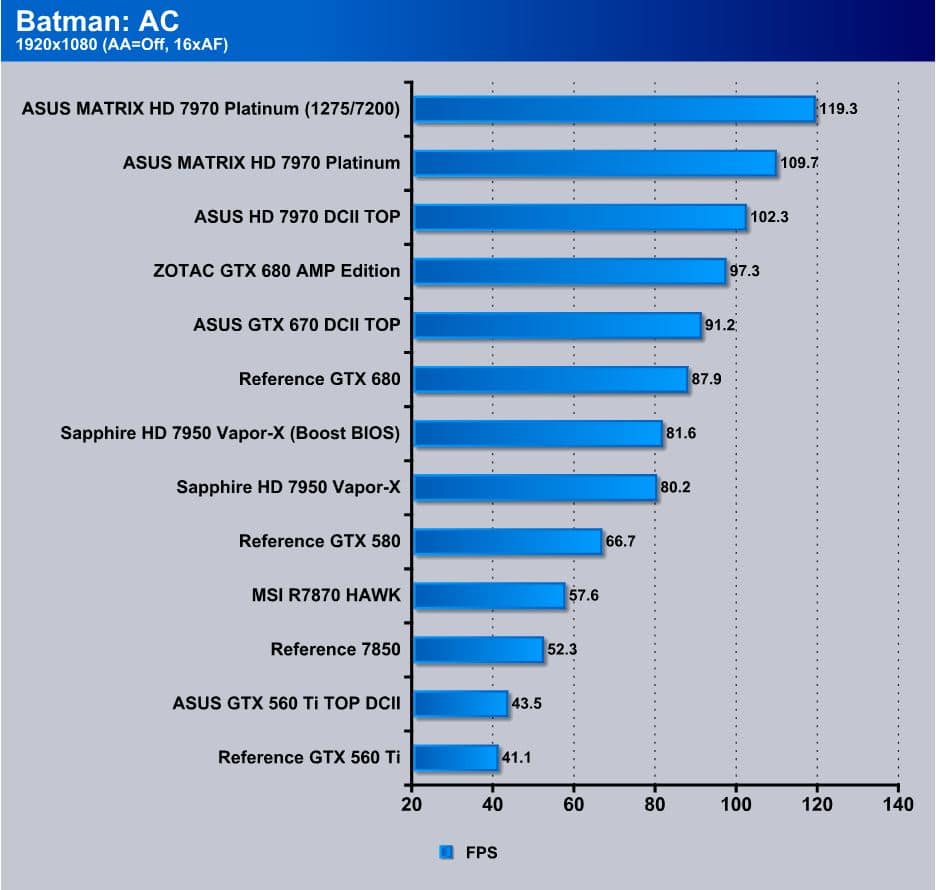
We tested Batman Arkham City and once again the MATRIX sweeps the field, especially once the overclock score comes in. We can only imagine how much more power the card has waiting in the reserve for some extreme cooling action.
Dirt 3

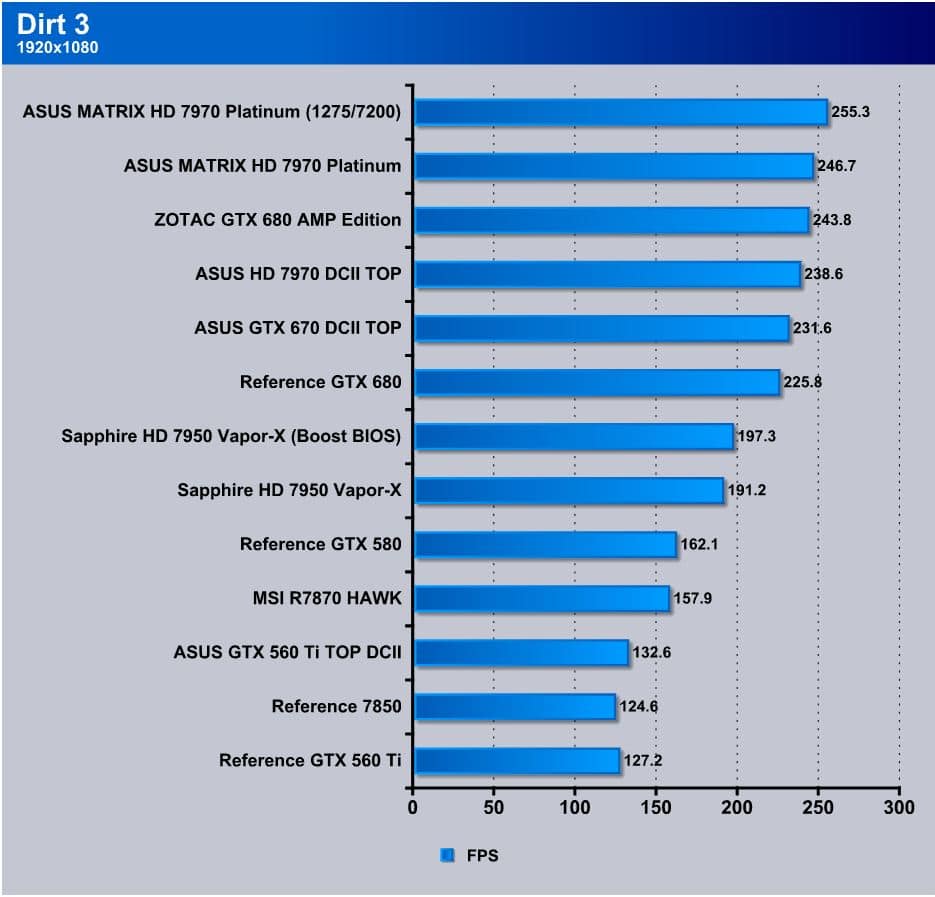
Dirt 3 surprised us, as the game is heavily marketed by AMD. Here though, the HD 7970 MATRIX barely comes out above the GTX 680. We figured it would have demolished it here. Once you tack on the overclock though, it pulls a very nice lead.




I don’t know this card can garner a perfect score. A fine piece of engineering it may be but it’s certainly not value for money & is a niche product. A score of 9 would probably be more fitting.
Hi there Wayne,
Normally I could understand where your coming from, if this were lets say a normal card with a non ref cooler or possible small changes. But this is an enthusiasts class card designed to compete with the likes of the MSI Lightning HD7970 (It costs 10 dollars less than the lightning) and therefore value has to be properly placed in respect to the market. I try to look at it similar to a collectors edition game bundle where at the end of the day its the same exact game in the box but in many cases fetches over 100% higher price just for the additional accessories or whatnot included in the box. well this card is only between 10-20% higher cost than the lowest priced standard models but has a much larger feature set than just another HD 7970.
Another example would be the automotive market, Yes a RS Camaro and a SS Camaro both have 4 wheels and the name “Camaro” on them but there are many differences that merit the price jump you pay for an SS version. Just think of the MATRIX HD 7970 as the “HD 7970 SS”
This is the kind of things we have to look at when we make an assesment of the relative value of a card to the market.
Awesome Review!!
Thank you for an un-biased review.
you’re welcome, and we do try. We try to review products for what they are so that you get a better idea of what the product is and where it fits…
Thank you for the reply.
And if you act now, we will throw-in an active “I am not using the card”, neon sign, so you know when you are not using it. Instead of actually just making the card do something that is actually beneficial to being used, while it is being used. Like, I don’t know… an actual exhaust that doesn’t require the use of 20 more fans to be added, thus, sucking all the power the card would have had available to use, if you actually used it. Instead of killing all the rest of the components inside the computer… The RAM, the PSU, the HD/SSD the CPU, the many added fans to actually TRY to exhaust the easy-bake-oven.
Oh, but it has lights! You like lights… Oh, my precious…. Gimme, gimme… All for only an additional $150 more then the original, for the $2.85 in additional hardware.
No Power Consumption for this Card?